
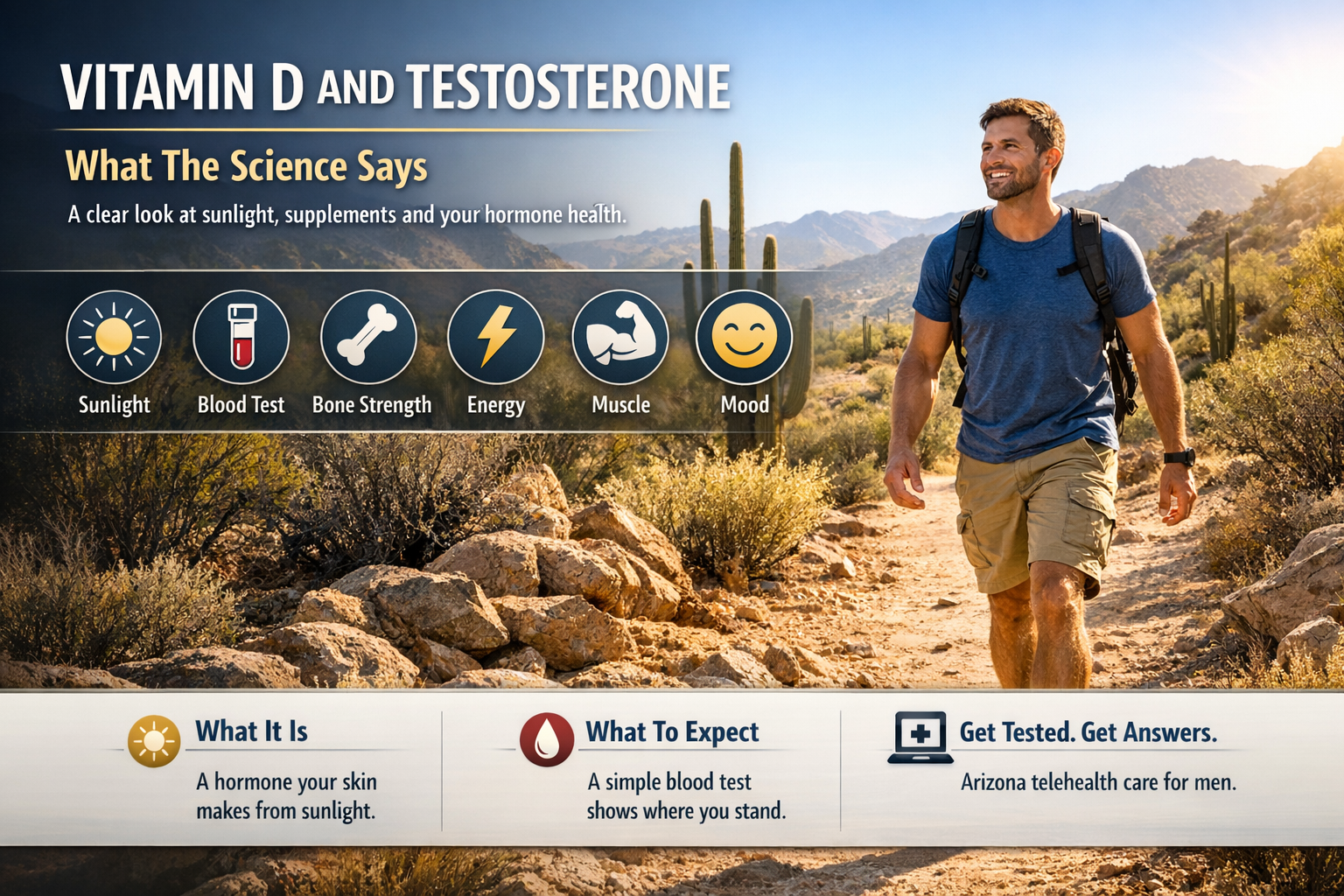
Does Vitamin D Boost Testosterone? An Arizona Guide
Does vitamin D boost testosterone? It is one of the most common questions we hear from Arizona men who are trying to fix their energy, drive and body composition without jumping straight to medication. The short version: vitamin D and testosterone are genuinely linked in the research, but the link is weaker and more conditional than supplement marketing suggests. Below is what the evidence actually shows, why Phoenix men are more deficient than you would expect in a state with 300 sunny days a year, and how to find out where you really stand.
Why vitamin D and testosterone are connected at all
Vitamin D is not really a vitamin. It is a hormone your skin manufactures when UVB light hits it, and your liver and kidneys then convert into its active form. Vitamin D receptors show up throughout the male reproductive system, including in the testes and in sperm cells — which is the biological reason researchers started looking for a testosterone connection in the first place.
The observational data is fairly consistent. Large cross-sectional studies have found that men with higher vitamin D levels tend to have higher total and free testosterone, and that both hormones follow a similar seasonal pattern, dipping in winter and rising in late summer. That is a real, repeatable association.
The problem is that association is not causation. Men with healthy vitamin D levels also tend to spend more time outdoors, carry less body fat, exercise more and sleep better — all of which independently support testosterone. Vitamin D may simply be a marker of a healthier lifestyle rather than the lever pulling testosterone up.
What the randomized trials actually found
This is where the story gets less exciting. When researchers run the controlled experiment — give one group vitamin D, give the other a placebo, and measure testosterone — the effect mostly disappears.
- A randomized controlled trial in healthy middle-aged men found no significant effect of vitamin D supplementation on total testosterone compared with placebo.
- A trial specifically in men who already had low testosterone levels also found no meaningful treatment effect on serum testosterone overall — though in a pre-specified subgroup of the most vitamin D deficient men, there were signals of improved testicular efficiency.
- A handful of smaller trials have reported increases, but they are generally short, small, and inconsistent with the larger body of evidence.
Put it together and a fair reading looks like this: if you are genuinely deficient, correcting it may nudge your hormonal machinery in the right direction. If your vitamin D is already adequate, more is not better — you will not stack testosterone by taking a bigger dose. That is the same pattern we see across most supplements, and it is why we wrote a longer piece on how TRT compares with natural testosterone boosters.
Stop guessing. Find out what your numbers actually say.
Doctor-supervised • Arizona-based • Telehealth available
Get Started — Free Assessment →The Arizona paradox: sunshine everywhere, deficiency anyway
You would assume men in Phoenix, Scottsdale, Mesa and Tucson are swimming in vitamin D. In practice, plenty are not — and the reasons are specific to how people actually live here.
- Heat drives you indoors. From May through September, most Valley residents move from an air-conditioned house to an air-conditioned car to an air-conditioned office. Peak UVB hours are exactly the hours nobody wants to be outside.
- Sunscreen and clothing. Good sun protection is smart in a state with high skin cancer rates — and it also blocks the UVB your skin needs to make vitamin D.
- Body fat sequesters it. Vitamin D is fat-soluble, so higher body fat means more of it gets stored in adipose tissue and less circulates. That matters because excess body fat also lowers testosterone directly, creating two problems at once.
- Darker skin tones need more exposure. Higher melanin is natural sun protection, which means significantly longer exposure is required to make the same amount of vitamin D.
Per the Cleveland Clinic's overview of vitamin D deficiency, the symptoms are frustratingly vague: fatigue, muscle weakness, aches, low mood and bone pain. Read that list again and you will notice it overlaps heavily with low testosterone. Two different problems, nearly identical complaints — which is exactly why bloodwork, not symptom-guessing, has to be the starting point.
How to actually find out where you stand
Both questions are answered with a simple blood draw, and they are usually ordered together.
- Vitamin D: measured as 25-hydroxyvitamin D, or 25(OH)D. This is the storage form and the accepted way to assess status. Levels below roughly 20 ng/mL are generally considered deficient, with 30 ng/mL and above widely treated as sufficient.
- Testosterone: total testosterone drawn in the morning, ideally on two separate days, plus free testosterone and SHBG for context. If you want the full picture of what the ranges mean, we broke down what a normal testosterone level looks like by age.
Arizona men can get both done at local draw sites across the Phoenix metro, Tucson and the East Valley, usually in under fifteen minutes. If you have never done this before, here is our step-by-step walkthrough of how to get your testosterone tested in Arizona, including what to fast for and when to schedule the draw.
What vitamin D is genuinely good for in men
Even if it will not fix low T, do not write vitamin D off. Adequate levels matter for calcium absorption and bone mineral density, for normal muscle function and strength, for immune regulation, and for mood. That bone point is not a footnote for men on hormone therapy — testosterone and bone health are tightly connected, which we cover in our piece on low testosterone and bone density.
Sensible sources include fatty fish like salmon and sardines, egg yolks, fortified dairy, and moderate, non-burning sun exposure. Supplementation is inexpensive and generally safe at typical doses — adults who do not get consistent sun exposure often take 800 to 2,000 IU of D3 daily, with higher corrective doses reserved for confirmed deficiency under a clinician's direction. Because it is fat-soluble, vitamin D can accumulate, so more is not automatically better. Dietary basics matter here too; our guide to the best foods for testosterone covers how the rest of your plate fits in.
When the real answer is low testosterone, not low vitamin D
If your vitamin D comes back normal — or you correct it, wait three months, and still feel flat — the honest conclusion is that vitamin D was not the problem. Persistent fatigue, low libido, eroding strength, poor recovery, irritability and brain fog, combined with repeat morning total testosterone below roughly 300 ng/dL and matching symptoms, is the clinical picture of hypogonadism. That is treated with medical therapy and ongoing lab monitoring, not with a supplement.
The useful thing is that finding out costs you one blood draw and a conversation. Optimizing vitamin D is a good idea regardless. It is just not a substitute for knowing your testosterone number.
Get your hormones checked by an Arizona clinic that does this all day.
Doctor-supervised • Arizona-based • Telehealth available
Get Started — Free Assessment →Frequently asked questions
How much vitamin D should a man take to raise testosterone?
There is no evidence-based dose that reliably raises testosterone, because randomized trials generally have not shown a meaningful testosterone increase from supplementing. A typical maintenance dose for adults with limited sun exposure is 800 to 2,000 IU of vitamin D3 daily. If your 25(OH)D level is confirmed low, a clinician may prescribe a higher corrective dose for a defined period, then re-test. Do not self-prescribe high doses long-term — vitamin D is fat-soluble and can build up.
How long does it take for vitamin D to affect testosterone?
If there is any hormonal effect at all, it would be gradual. Vitamin D stores themselves take roughly eight to twelve weeks of consistent supplementation to move meaningfully, which is why most clinicians re-check 25(OH)D at about three months. If you have corrected your vitamin D, waited a full quarter, and your symptoms have not changed, that is a strong signal something else is driving them.
Can I be vitamin D deficient living in Arizona?
Yes, and it is more common than people expect. Arizona summers push most of us indoors during peak UVB hours, sunscreen blocks the wavelength your skin needs, higher body fat stores vitamin D away from circulation, and darker skin requires longer exposure to produce the same amount. Living in a sunny state does not guarantee a normal level — only a 25(OH)D blood test does.
Sources
- Association between plasma 25-OH vitamin D and testosterone levels in men — PMC, National Library of Medicine
- Vitamin D and Testosterone in Healthy Men: A Randomized Controlled Trial — PubMed, National Library of Medicine
- Effects of vitamin D supplementation on androgens in men with low testosterone levels: a randomized controlled trial — PMC, National Library of Medicine
- Vitamin D Deficiency: Causes, Symptoms & Treatment — Cleveland Clinic
