
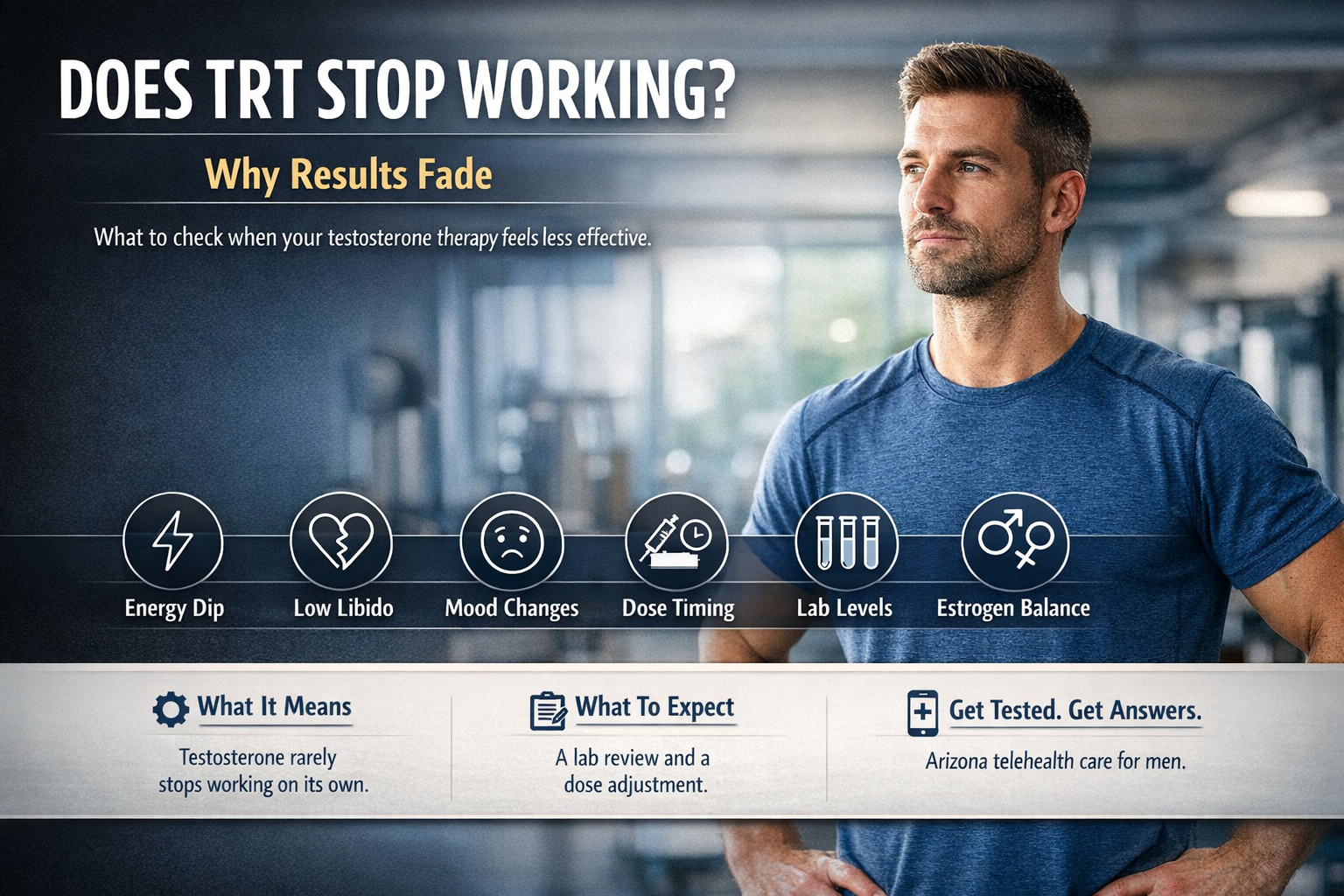
Does TRT Stop Working Over Time? Causes & What to Do
If you are three months, a year, or five years into treatment and wondering does TRT stop working over time, you are asking one of the most common questions men bring back to an Arizona TRT clinic. The energy came back, the gym felt good again, your head was clear — and then, gradually, some of it slipped. It is a frustrating place to be, and it is also one of the most fixable.
Here is the honest framing: testosterone therapy is not a drug your body becomes desensitized to. What changes is the fit between your protocol and your current physiology. Below is how clinicians actually work through it.
Why "TRT tolerance" is mostly a myth
Tolerance, in the pharmacological sense, means your body needs more of a drug to get the same effect because receptors downregulate or the drug is cleared faster. That is not what happens with testosterone in men on a properly monitored replacement protocol. Testosterone is a hormone your body already makes and already has receptors for. Replacement restores a physiologic level; it does not flood a system into shutting down its response.
Major clinical guidance reflects this. Both the American Urological Association's testosterone deficiency guideline and the Endocrine Society's testosterone therapy guideline frame TRT as an ongoing, monitored therapy: you check levels, you check symptoms, and you adjust. The expectation built into the guidelines is that protocols get tuned over time — not that they degrade.
So if the benefit faded, the question is not "did my receptors quit?" It is "what changed?"
Seven real reasons your TRT feels like it stopped working
1. Your dose or injection frequency no longer fits you
This is the single most common explanation. Body weight, body composition, SHBG, and how quickly you clear testosterone all affect where your levels land on a given dose. A protocol that put you comfortably mid-range two years ago may now be leaving you low at the end of the week. This is a numbers problem, not a willpower problem — and it is why knowing what your testosterone level should actually be on TRT matters more than knowing your starting dose.
2. You are comparing today to the honeymoon, not to baseline
The first eight to sixteen weeks on TRT often feel dramatic because the contrast is dramatic. Once you have been at a healthy level for a while, that level becomes your new normal, and the day-to-day feels less like a revelation. That is not the therapy failing — that is adaptation. Rereading the realistic TRT timeline for when each benefit shows up is often enough to recalibrate expectations.
3. Estradiol has drifted out of range
Testosterone aromatizes into estradiol, and men need some estradiol for libido, mood, joints, and bone health. Too little and you feel flat, achy, and unmotivated — symptoms that look exactly like low T. Too much and you get water retention, moodiness, and nipple sensitivity. Research on managing the adverse effects of testosterone therapy notes that estradiol above roughly 60 pg/mL is associated with gynecomastia and is typically addressed with dose or medication adjustments. If your protocol was never revisited, estrogen (E2) management on TRT is one of the first places a good provider looks.
4. Missed, late, or inconsistent doses
Testosterone cypionate and enanthate have predictable half-lives, which means a shifted injection day produces a predictable trough. A man who injects "roughly weekly, sometimes ten days" is living in a rollercoaster he may not connect to how he feels on Thursday. Skipped doses have a bigger effect on results than most men expect.
5. Something else changed in your life
Fatigue, low drive, and brain fog are not testosterone-specific symptoms. Weight gain, a new sleep problem, untreated sleep apnea, heavy alcohol use, chronic stress, a thyroid shift, anemia, or a new prescription (including some blood pressure and antidepressant medications) can all reproduce the exact complaints that brought you to TRT in the first place. Blaming the testosterone is easy. Ruling out the rest is what actually gets you better.
6. Your hematocrit climbed and you feel it
Testosterone stimulates red blood cell production, and some men develop erythrocytosis — thickened blood — on therapy. The literature on erythrocytosis following testosterone therapy describes a dose-related relationship, with monitoring generally aimed at keeping hematocrit below 54%. Men with a rising hematocrit often report headaches, sluggishness, and poor workouts — which reads as "TRT stopped working" but is really a monitoring flag. In Arizona's summer heat, where dehydration is a year-round risk, this is worth taking seriously.
7. Low testosterone was never the whole story
If your pre-treatment level was borderline and your symptoms were driven mostly by something else, TRT may have delivered a modest, real, but limited benefit that was always going to be partial. That is a diagnostic question worth revisiting rather than a reason to keep raising the dose.
Feel like your TRT isn't working anymore?
Doctor-supervised • Arizona-based • Telehealth available
Get Started — Free Assessment →What a stalled protocol usually looks like on labs
You cannot troubleshoot this by feel alone. A proper re-evaluation draws blood at a consistent point in your cycle — usually the trough, right before your next dose — and looks at the full picture rather than one number:
- Total and free testosterone — free testosterone often explains symptoms better than total, especially when SHBG is high.
- SHBG — a rise here can leave plenty of total testosterone bound and unavailable.
- Estradiol (sensitive assay) — too high or too low both produce complaints.
- Hematocrit and hemoglobin — the safety check that doubles as a symptom clue.
- Thyroid panel, ferritin, vitamin D, A1c — the usual suspects behind fatigue that testosterone will not fix.
- PSA — routine safety monitoring for men on therapy.
Timing matters as much as the panel. A trough draw on a Monday compared against a peak draw from last year tells you almost nothing useful.
How the fix usually works
Once the labs are in, the adjustments are rarely dramatic. Most men fall into one of four buckets:
- Split the dose. Moving from one weekly injection to two or three smaller ones smooths peaks and troughs, often improving both symptoms and hematocrit without raising the total weekly amount. This is one of the most reliable levers for men who feel great for four days and flat for three.
- Adjust the dose modestly. If the trough level genuinely sits below the target range, a measured increase makes sense. If it is already mid-range, more testosterone is usually the wrong answer — understanding how TRT dosing is actually determined helps explain why.
- Address estradiol. Sometimes by adjusting dose or frequency; sometimes with a low-dose aromatase inhibitor, used carefully and only when labs and symptoms agree.
- Treat what is not testosterone. Sleep study, weight management, iron, thyroid, or a medication review — whichever the workup points to.
The Arizona angle
For men across Phoenix, Scottsdale, Mesa, Tempe, Chandler, Gilbert, and Tucson, two local realities matter here. First, heat and dehydration make a rising hematocrit more consequential, so hydration and regular monitoring deserve extra attention from May through September. Second, telehealth removes most of the friction that causes men to coast on a stale protocol for years — a video consult plus a lab draw at a local Arizona lab is a far lower bar than taking a morning off work, which means protocols actually get reviewed on schedule instead of drifting.
When to ask for a re-evaluation
Bring it up if you notice a sustained return of fatigue, low libido, mood changes, or poor recovery for more than three to four weeks; if your energy reliably crashes in the days before your next dose; if you have gained significant weight or started a new medication; or if it has simply been more than six months since anyone looked at your labs. None of those are reasons to quit. They are reasons to recalibrate.
Get your protocol reviewed by an Arizona provider
Doctor-supervised • Arizona-based • Telehealth available
Get Started — Free Assessment →Frequently asked questions
Can you build a tolerance to testosterone?
Not in the way you build a tolerance to caffeine or a painkiller. Androgen receptors do not meaningfully desensitize on a physiologic replacement dose. When men say they have built a tolerance, lab work usually shows a dosing, timing, estradiol, or unrelated-health explanation instead.
Why does my TRT work for a few days and then wear off?
That pattern points to trough levels falling too low between injections. Splitting the same weekly amount into two or three smaller, more frequent doses usually flattens the curve and removes the end-of-week crash. A trough lab draw confirms it.
Should I just increase my testosterone dose if I feel worse?
Not without labs. If your trough level is already in the target range, more testosterone typically adds side-effect risk — higher hematocrit, more estradiol conversion — without adding benefit. The right next step is a full panel and a conversation with your provider.
Sources
- Evaluation and Management of Testosterone Deficiency: AUA Guideline — American Urological Association
- Testosterone Therapy for Hypogonadism: Clinical Practice Guideline Resources — Endocrine Society
- Management of Adverse Effects in Testosterone Replacement Therapy — PubMed Central (NIH)
- Erythrocytosis Following Testosterone Therapy — PubMed Central (NIH)
