
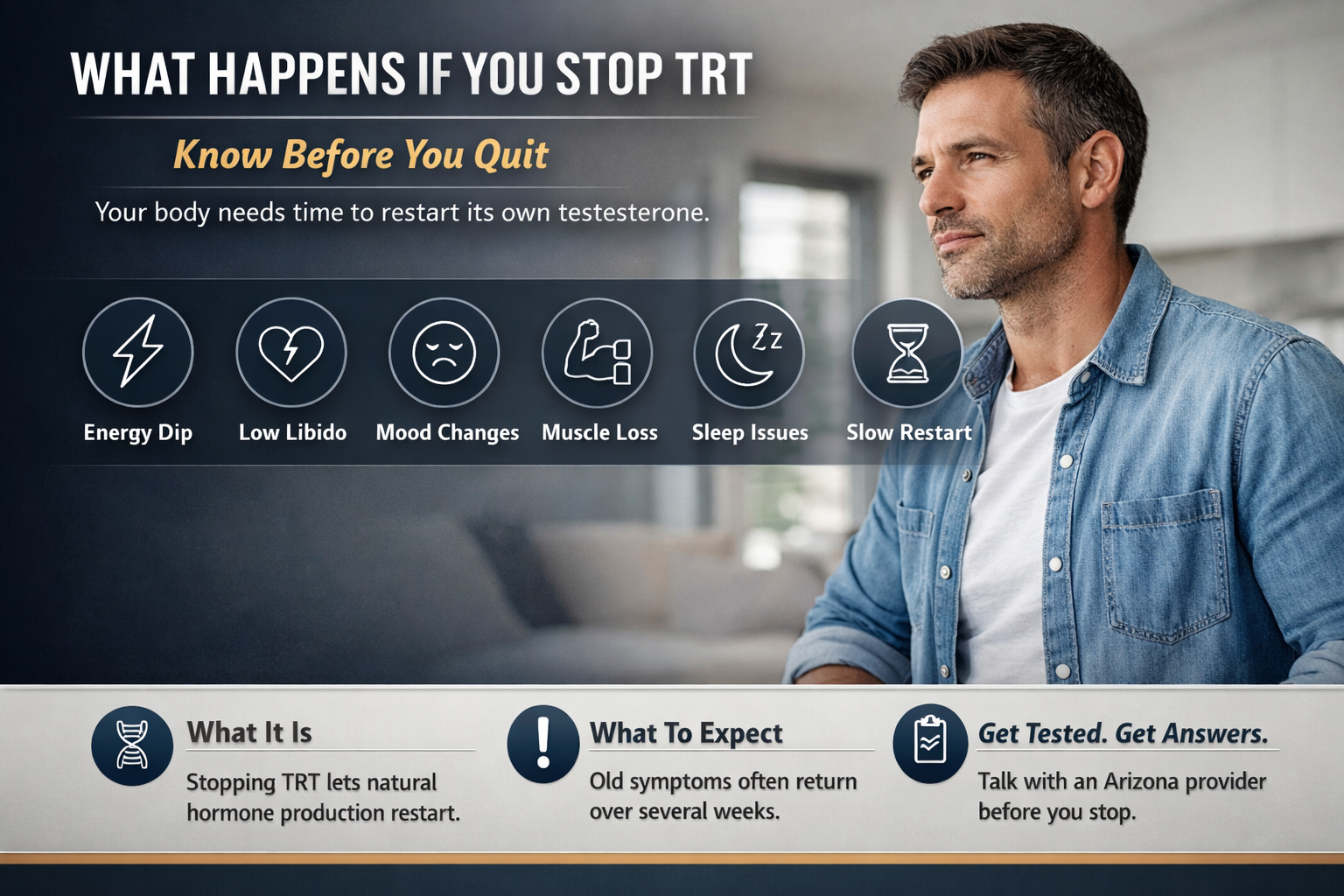
What Happens If You Stop TRT? What Arizona Men Should Know
Wondering what happens if you stop TRT is one of the most common questions Arizona men ask before they ever start testosterone replacement therapy — and one of the most common questions they ask again a year or two in. Maybe you are moving, changing jobs, rethinking the cost, trying to have a child, or simply curious whether your body can pick up where it left off. The honest answer is that stopping testosterone therapy is reversible for most men, but it is rarely instant, and the transition period is where most of the discomfort lives.
Here is what actually happens in your body when testosterone therapy ends, how long the adjustment usually takes, and how men in Phoenix, Scottsdale, Mesa, and across the Valley can come off treatment thoughtfully instead of abruptly.
Why your body stops making its own testosterone on TRT
Your testicles do not produce testosterone on their own schedule. They respond to signals from the brain — specifically luteinizing hormone (LH) and follicle-stimulating hormone (FSH) released by the pituitary gland, which is in turn directed by the hypothalamus. Together these three structures are called the hypothalamic-pituitary-gonadal (HPG) axis, and it works like a thermostat.
When you introduce testosterone from outside the body, the thermostat reads your blood levels as sufficient and dials the signal down. LH and FSH fall. The Leydig cells in your testicles, no longer being told to work, largely go quiet. This is expected and is not a sign that something has gone wrong — it is simply how the feedback loop behaves. It is also why clinical guidelines emphasize measuring LH before starting therapy and monitoring men on an ongoing basis.
The practical consequence: when you stop the outside supply, there is a gap. Exogenous testosterone leaves quickly. The HPG axis takes considerably longer to wake back up.
The timeline: what to expect after your last dose
Timelines vary based on the ester you were using, your dose, how long you were treated, your age, and what your baseline testosterone looked like before you ever started. That said, the general pattern is fairly consistent.
- Days 1–14. Testosterone cypionate and enanthate have half-lives measured in days, so blood levels taper rather than crash. Many men feel essentially normal through the first week or two, which is why some assume nothing is going to change.
- Weeks 2–6. Levels bottom out. This is usually the roughest stretch. Fatigue, reduced libido, weaker erections, lower mood, poorer sleep, and irritability commonly surface here — the same cluster that makes up the classic signs of low testosterone in men. During this window your own production has not yet recovered, so you can temporarily sit below your original baseline.
- Months 2–6. For most men, LH and FSH begin climbing and natural production resumes. Energy and mood typically stabilize somewhere near where they were before treatment started.
- Beyond 6 months. A minority of men recover more slowly. Research on prolonged suppression following long-term exogenous androgen exposure has documented cases in which hypogonadism persisted well past a year after stopping, particularly with high-dose, long-duration use.
An important reframe: these are not "withdrawal" symptoms in the addiction sense. Testosterone is not habit-forming. What you are feeling is the absence of a hormone your body had gotten used to receiving — and, in most cases, a return to the deficiency you were treating in the first place. If you remember how long TRT took to work when you started, coming off tends to run a similar arc in reverse.
Thinking about stopping? Talk to an Arizona provider first.
Doctor-supervised • Arizona-based • Telehealth available
Get Started — Free Assessment →Do the benefits disappear completely?
Not all at once, and not uniformly. The gains most tied to circulating testosterone — libido, erection quality, energy, and mood — tend to fade first, generally within the first one to two months. Muscle mass and strength decline more gradually, and how much you keep depends heavily on whether you continue training and eating well. Body fat, particularly around the midsection, often creeps back over months rather than weeks.
Interestingly, not every man reverts completely. A study of men who discontinued testosterone treatment found that some retained a portion of their symptom improvement after cessation, with baseline characteristics helping predict who held on to benefits and who did not. Men whose low testosterone was driven by reversible factors — significant excess weight, untreated sleep apnea, chronic stress, certain medications — sometimes find their natural levels land higher than where they started, because those underlying drivers improved along the way.
The men most likely to feel a hard drop are those with true primary or secondary hypogonadism, where the underlying cause has not changed. For that group, the question is less "will symptoms return" and more whether staying on TRT long term is the right plan.
Common reasons Arizona men stop — and better alternatives
Trying to conceive
This is the most legitimate medical reason to change course. Because TRT suppresses FSH and LH, it also suppresses sperm production, sometimes to zero. Stopping cold is one option, but it is usually not the best one. Protocols using hCG and selective estrogen receptor modulators are commonly used to restore sperm production faster, and many men can preserve fertility while staying on therapy. Our deeper guide to TRT and fertility walks through the options before you stop anything.
Cost or convenience
Injections, labs, and follow-ups add up. Before quitting outright, it is worth reviewing dosing frequency, delivery method, and lab cadence with your provider. Telehealth-based care in Arizona — with local draw sites in Phoenix, Tempe, Chandler, Gilbert, and Tucson — has removed a lot of the friction that used to push men to quit.
Side effects
Elevated hematocrit, estrogen-related symptoms, acne, or sleep disruption are usually manageable with dose adjustments, injection frequency changes, or a therapeutic phlebotomy — not a reason to abandon treatment entirely. Mayo Clinic notes that testosterone therapy carries real risks that warrant monitoring, which is exactly why supervised care matters more than the decision to start or stop in isolation.
Wanting your natural production back
Some men simply want their own axis running again. If that is the goal, a monitored restart protocol makes far more sense than going cold turkey. For men who want a stimulation-based approach rather than replacement, it is worth understanding how enclomiphene compares to TRT.
Get a plan built around your labs — not guesswork.
Doctor-supervised • Arizona-based • Telehealth available
Get Started — Free Assessment →How to stop TRT the right way
If you and your provider decide stopping is appropriate, a structured exit beats an abrupt one.
- Tell your provider before your last dose, not after. A planned taper and a recovery protocol are far easier to set up in advance than to retrofit three miserable weeks later.
- Consider a taper. Gradually reducing the dose over several weeks softens the drop rather than dropping you off a cliff.
- Ask whether a restart protocol fits. hCG and SERMs such as clomiphene or enclomiphene are commonly used to stimulate the axis, especially when fertility is the goal.
- Keep testing. Baseline labs before stopping, then follow-up total and free testosterone, LH, FSH, estradiol, and CBC at roughly six weeks, three months, and six months tells you whether recovery is actually happening.
- Protect the fundamentals. Sleep, resistance training, protein intake, alcohol reduction, and treating sleep apnea all support natural production — and they matter most during the gap.
- Give it time before judging. Six weeks off is not a verdict. Three to six months of data is.
Warning signs that warrant a call
Reach out to your provider promptly if you experience severe or worsening depressed mood, thoughts of self-harm, extreme fatigue that interferes with daily function, or symptoms that have not improved at all by the six-month mark. Persistent hypogonadism after stopping is uncommon but treatable, and it is not something to wait out indefinitely.
Frequently asked questions
How long does it take to recover natural testosterone after stopping TRT?
Most men see their own production begin recovering within about three to six months, though some rebound faster and a minority take a year or longer. Recovery is generally slower after higher doses and longer durations of therapy, and older men tend to recover more slowly than younger men.
Is it dangerous to stop testosterone therapy suddenly?
For most healthy men it is not medically dangerous, but it is uncomfortable. Stopping abruptly means several weeks in a hormonal trough with fatigue, low libido, and mood changes. A planned taper and a monitored recovery protocol make the transition considerably easier, which is why you should coordinate with your provider first.
Will I lose all my muscle if I stop TRT?
No. Strength and muscle decline gradually over months, not days, and consistent resistance training plus adequate protein preserves a meaningful portion of what you built. You will likely lose some of the edge that higher testosterone provided, but you do not reset to where you were before you ever trained.
Sources
- Evaluation and Management of Testosterone Deficiency: AUA Guideline — American Urological Association
- Testosterone therapy: Potential benefits and risks as you age — Mayo Clinic
- Predictive Factors of Efficacy Maintenance after Testosterone Treatment Cessation — PubMed Central (NIH)
- Prolonged Hypogonadism in Males Following Withdrawal from Anabolic-Androgenic Steroids — PubMed Central (NIH)
