
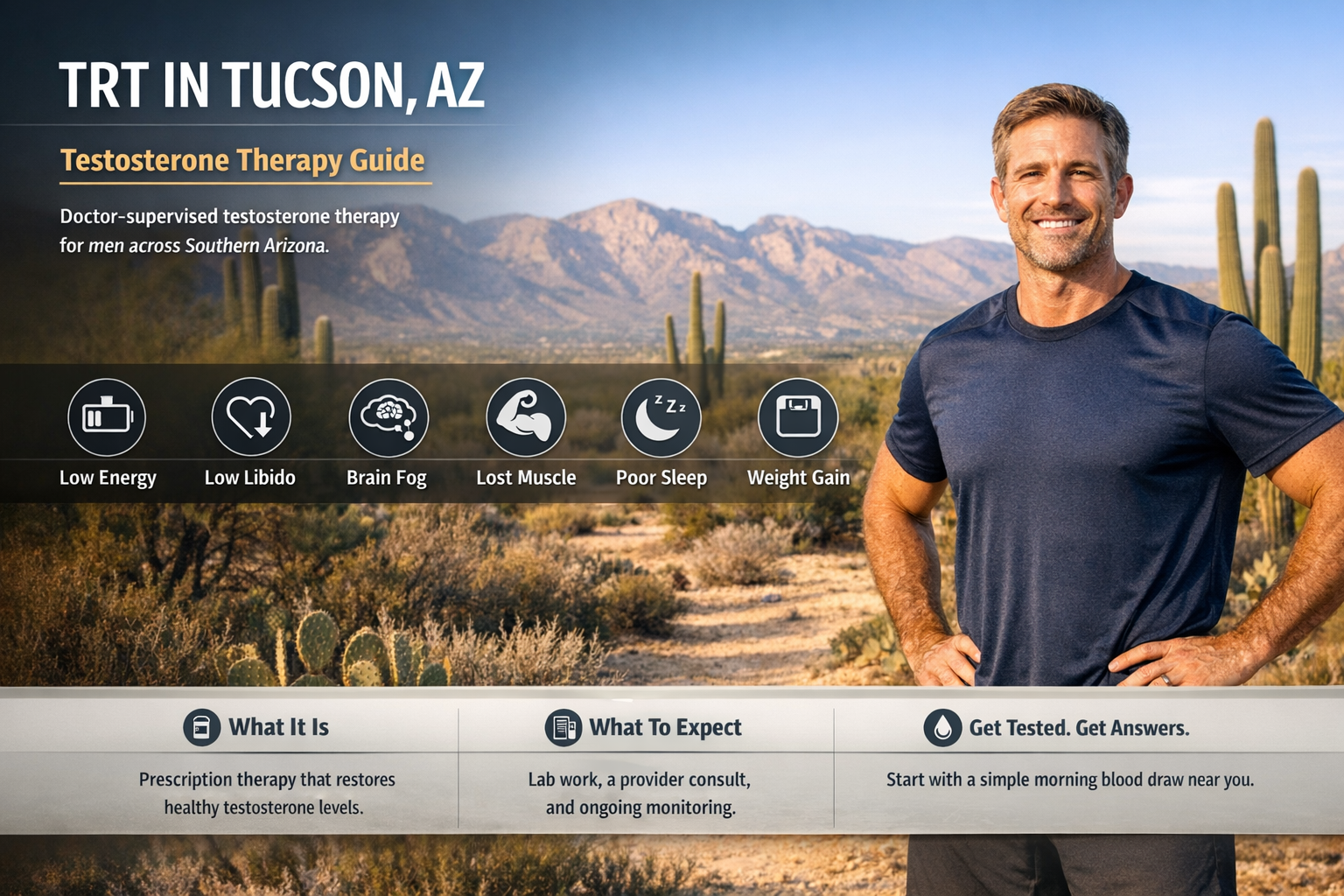
TRT in Tucson, AZ: How to Start Testosterone Therapy
If you have been searching for TRT in Tucson, AZ, you are probably somewhere between "something feels off" and "I want an actual answer." Testosterone replacement therapy is a prescription treatment for men whose testosterone is genuinely low and who have symptoms to match — flat energy, fading libido, stubborn weight, poor sleep, workouts that stopped paying off. This guide walks through how men in Tucson and across Southern Arizona get tested, what the diagnosis really requires, what treatment looks like month to month, and how to tell a legitimate clinic from a pill-mill.
Why so many Tucson men are looking into TRT
Tucson skews toward exactly the population most likely to notice a testosterone problem: men in their 30s through 60s who are active, outdoors, and used to performing. When you hike Sabino Canyon every spring and this year it wrecks you, or you have been lifting consistently for a decade and suddenly cannot hold muscle, that change registers.
Low testosterone — clinically, male hypogonadism — produces a recognizable cluster of complaints. Reduced libido, erectile difficulty, loss of muscle mass, increased body fat, low mood, and low energy are the ones men report most. The tricky part is that every one of those symptoms has other possible explanations, which is why guessing is a bad strategy and testing is the only honest starting point. If you want the full symptom picture first, our guide to the most common signs of low testosterone in men covers what to watch for.
How the diagnosis actually works
This is where good clinics separate themselves from bad ones. A single lab draw at 4 p.m. after a bad night of sleep is not a diagnosis. Testosterone follows a daily rhythm and peaks in the morning, so timing matters enormously.
The American Urological Association's guidance is specific: a total testosterone below 300 ng/dL on two separate early-morning tests, paired with symptoms, is the threshold that supports a diagnosis of testosterone deficiency. Two tests. Morning. Same lab where possible. Symptoms present.
A proper Tucson-area workup usually includes:
- Total testosterone — the headline number, drawn before 10 a.m.
- Free testosterone and SHBG — because the hormone bound to protein is not the hormone doing the work
- LH and FSH — these distinguish a testicular problem from a pituitary signaling problem
- Estradiol (E2) — a baseline for managing side effects later
- CBC with hematocrit, PSA, a metabolic panel, thyroid, and often prolactin — safety baselines and rule-outs
Tucson has no shortage of draw sites — national lab networks operate locations across Midtown, the east side, Oro Valley, Marana, and near the University of Arizona campus. If you want the step-by-step version, we wrote a full walkthrough on how to get your testosterone tested in Arizona, including how to order labs without a referral.
Find out where your testosterone really stands
Doctor-supervised • Arizona-based • Telehealth available
Get Started — Free Assessment →In-person clinic or telehealth in Tucson?
Tucson men historically had two unappealing options: a urology practice with a months-long wait, or a primary care office that ran one afternoon test and said the number looked "fine." Arizona's telehealth framework changed that. State law permits providers to evaluate patients and prescribe without requiring a prior in-person visit for most medications, which means testosterone therapy can be managed remotely by an Arizona-licensed clinician.
Practically, that looks like this for a man in Tucson:
- You complete an intake and book a video consult.
- Lab orders are sent electronically to a draw site near you — Midtown, the east side, Oro Valley, wherever is convenient.
- You go in fasting, early morning, and the results route back to your provider.
- If treatment is appropriate, your prescription ships to your door.
- Follow-up labs and check-ins happen on a schedule, not whenever you remember.
The clinical standard does not loosen because the visit is virtual — the same lab confirmation and the same monitoring apply. Our breakdown of how online TRT works in Arizona through telehealth goes deeper on the logistics, including what happens if your labs come back normal.
What treatment and monitoring look like
Most men on TRT use testosterone cypionate, injected weekly or twice weekly, often subcutaneously with a small insulin-style needle at home. Gels, creams, and pellets exist and suit some men better. Dosing is individual and adjusted based on follow-up labs and how you actually feel — not on a one-size template.
Monitoring is the part that makes TRT safe, and it is non-negotiable. Ongoing care should include periodic testing of testosterone levels, PSA, and hematocrit. Testosterone can thicken the blood by raising red blood cell count, and that is the side effect most likely to require a dose change or a therapeutic blood draw.
Prostate monitoring gets the most questions. The older fear that testosterone directly causes prostate cancer has not held up, but PSA can rise after starting therapy, so baseline and repeat PSA testing is standard for men in the screening age range. A typical rhythm: labs at roughly six to eight weeks, again around six months, then every six to twelve months once you are stable.
One Tucson-specific note — Southern Arizona summers run hot, and testosterone vials should be stored at controlled room temperature. Do not leave your medication in a parked car on Speedway in July, and do not let a delivery sit on the porch all afternoon.
How to choose a TRT clinic in Tucson
The men's-health market has real clinics and predatory ones. Signals worth trusting:
- Two morning labs before any prescription. If a clinic will prescribe off a questionnaire, leave.
- A licensed Arizona provider you can actually talk to — not just a coordinator.
- Monitoring included in the price, not billed as a surprise every quarter.
- Transparent pricing. Our breakdown of what TRT costs in Arizona gives you a benchmark to compare against.
- Willingness to say no. A clinic that treats every man who walks in is selling, not practicing medicine.
Red flags run the other way: no bloodwork, mandatory stacked add-ons, pressure to buy a year upfront, or a "clinic" that cannot name the prescribing provider. The same evaluation checklist we published for choosing a TRT clinic in Phoenix applies identically in Pima County.
Tucson men: get real answers, not guesses
Doctor-supervised • Arizona-based • Telehealth available
Get Started — Free Assessment →What to expect in the first few months
Timelines vary, but the general pattern is consistent: mood, energy, and libido tend to shift first, over the early weeks. Sleep quality and mental clarity often follow. Body composition changes — more lean mass, less fat — are the slowest and depend heavily on whether you are training and eating like someone who wants them.
TRT is not a shortcut around the basics. It restores a hormone to a normal range; it does not replace sleep, protein, or resistance training. Men who treat it as one input among several get the best outcomes. Men who expect it to fix everything are usually disappointed.
Frequently asked questions
Can I get TRT in Tucson without an in-person doctor visit?
In most cases, yes. Arizona permits licensed providers to evaluate and prescribe via telehealth without requiring a prior in-person visit for most medications. You still need real bloodwork — you will visit a Tucson-area lab for an early-morning draw — but the consultations themselves can be done by video from home.
How do I get my testosterone tested in Tucson?
A provider orders your panel electronically, and you visit a local draw site in Midtown, on the east side, in Oro Valley, or wherever is closest. Go early in the morning, ideally fasting. Because a diagnosis requires two confirming morning tests, plan on going twice before any treatment decision is made.
What testosterone level is low enough to qualify for TRT?
Guideline-based practice uses a total testosterone under 300 ng/dL on two separate early-morning tests, combined with symptoms, as the threshold supporting a testosterone-deficiency diagnosis. The number alone is not enough — a man at 280 ng/dL with no symptoms and a man at 280 ng/dL with fatigue and low libido are different clinical situations.
Sources
