
How to Read Your Hormone Lab Results: A Men's Guide
Getting a lab report back with a page of numbers and reference ranges can be confusing. Here's a general orientation — though your provider's interpretation always matters most.
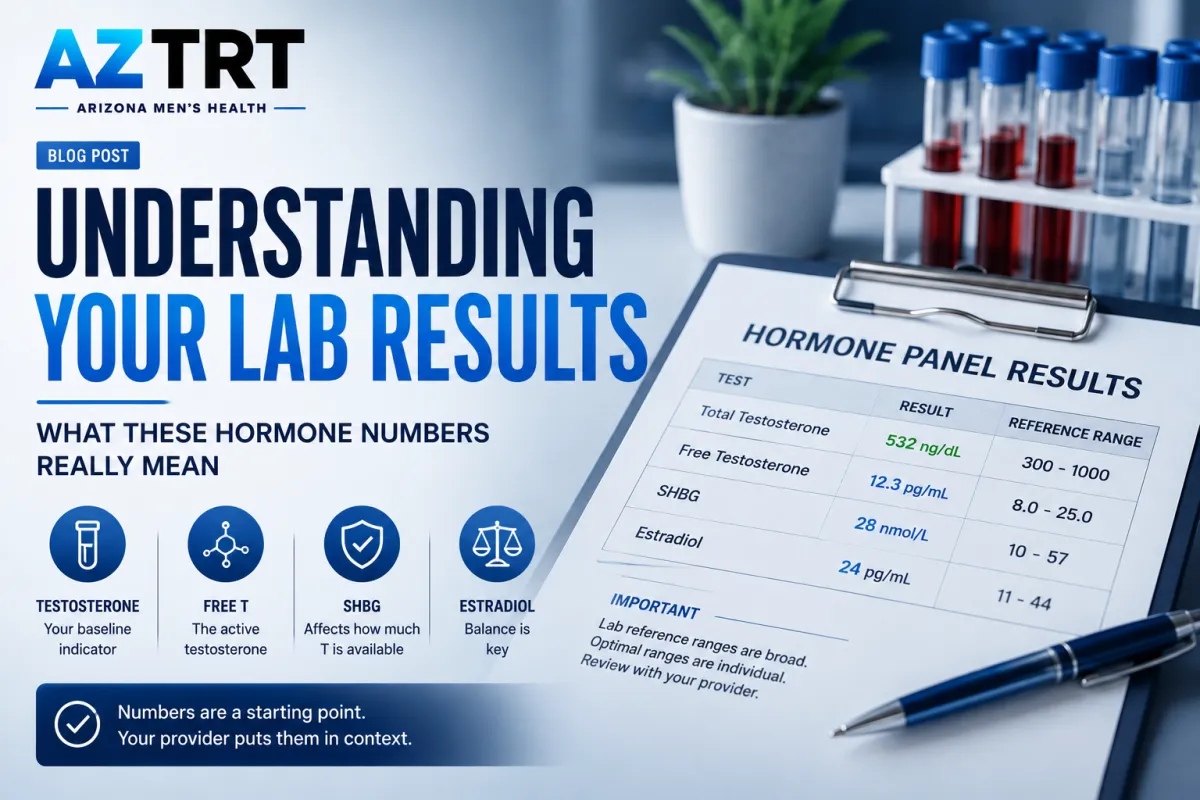
Total testosterone
This measures all the testosterone in your blood, both bound to proteins and freely available. It's the most commonly referenced number, but it doesn't tell the whole story on its own.
Free testosterone
This measures the testosterone that's actually available for your body to use — not bound to proteins. Some men have "normal" total testosterone but low free testosterone, which can still cause symptoms.
SHBG (sex hormone-binding globulin)
This protein binds to testosterone in the blood. Higher SHBG means less free testosterone available, even if total levels look fine — which is part of why looking at total testosterone alone can be misleading.
Estradiol
A form of estrogen that men also produce, partly through the conversion of testosterone. Balance matters here — too high or too low can both contribute to symptoms.
Reference ranges aren't everything
Lab reference ranges are often broad, covering a wide age range. Being "within range" doesn't automatically mean your levels are optimal for you — this is where a provider's clinical judgment, combined with your symptoms, comes in.
The real takeaway
Numbers on a page are a starting point, not a diagnosis by themselves. Review your results with your provider, who can put them in context with how you're actually feeling.
Curious where you stand? You can book a free, no-obligation consult with an Arizona-licensed provider any time — it takes about 60 seconds to get started, and our FAQ covers most of what people ask before their first visit.
If this was useful, you may also want to read our post on Understanding Enclomiphene: An Alternative to Traditional TRT, or browse the full AZTRT blog for more Arizona men's health guides.
