
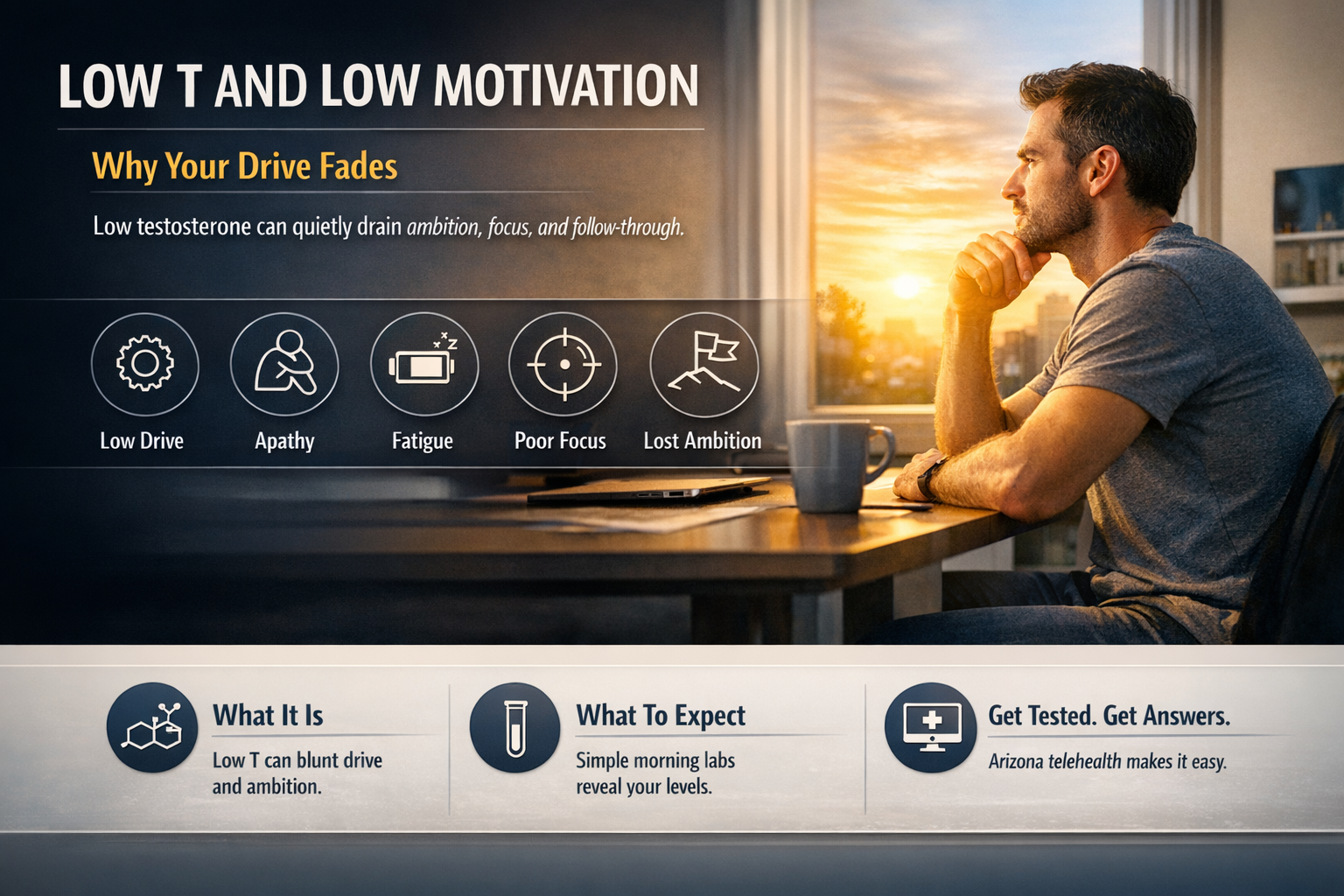
Low Testosterone and Low Motivation: Why Your Drive Is Gone
If you've been searching for answers about low testosterone and low motivation, you're probably describing something like this: the goals are still there, but the fire behind them is gone. Workouts you used to look forward to feel like chores. Projects sit half-finished. You're not exactly sad — you just don't care the way you used to. For a lot of men in Phoenix and across Arizona, that creeping loss of drive isn't a character flaw or burnout alone. It's hormonal — and it's testable.
Why testosterone fuels motivation
Motivation isn't willpower. It's chemistry. Deep in the brain, dopamine-driven reward circuits decide what feels worth pursuing — and testosterone helps keep those circuits firing. Testosterone receptors are concentrated in the same brain regions that govern reward, ambition, and goal-directed behavior. When testosterone runs low, dopamine signaling tends to weaken with it.
The result is a symptom doctors call apathy: a flattening of drive and initiative. Men describe it as:
- Losing interest in hobbies, competition, or the gym
- Struggling to start tasks — even ones that matter
- Feeling indifferent about wins that used to feel great
- Coasting at work instead of pushing for more
- Needing caffeine or deadlines just to get moving
This is one of the earliest and most overlooked symptoms of low T. Because it builds slowly over months or years, most men blame age, stress, or themselves long before they think to check a hormone level.
Signs your low drive is hormonal
Low motivation on its own has many causes. But when it travels with other low-testosterone symptoms, the pattern points toward your hormones. Ask yourself whether the loss of drive comes with:
- Persistent fatigue — tired even after a full night's sleep
- Lower sex drive — noticeably less interest than a year or two ago
- Brain fog — trouble focusing or finishing thoughts
- Flat or irritable mood — a shorter fuse, less enjoyment
- Slipping gym results — losing strength or muscle despite training
- More belly fat — weight creeping on around the midsection
Two or more of these alongside low motivation is a strong signal that bloodwork is worth doing. Testosterone naturally declines roughly 1% per year after age 30, so this cluster is common in Arizona men in their 30s, 40s, and 50s — often years before anyone uses the words "low T."
Low motivation vs. depression: how to tell the difference
This distinction matters, because the two are treated very differently. Depression usually involves persistent sadness, hopelessness, guilt, or loss of pleasure in nearly everything. Hormonal apathy feels different: men with low T often say they're not sad — they simply feel neutral, unmotivated, and flat. The desire to want things is what's missing.
The two can also overlap. Research has linked low testosterone with higher rates of depressive symptoms in men, and restoring normal levels can improve mood and drive in men who are clinically low. That's exactly why testing matters: a $100 lab panel can rule low T in or out, rather than guessing. If you're experiencing true depression — especially with hopelessness or thoughts of self-harm — talk to a mental health professional promptly, whatever your hormone levels turn out to be.
Feel Like Your Drive Disappeared?
Arizona-licensed providers • Arizona-based • Telehealth available
Get Started — Free Assessment →What else can drain your drive
An honest evaluation rules out the other usual suspects before blaming testosterone. Common motivation-killers include:
- Poor sleep and sleep apnea — both crush dopamine and lower testosterone, creating a double hit
- Chronic stress — elevated cortisol suppresses testosterone production over time
- Thyroid problems — an underactive thyroid mimics many low-T symptoms
- Medications — some antidepressants, opioids, and blood pressure drugs blunt drive or lower T
- Low vitamin D or anemia — easy to check on the same blood draw
A good TRT clinic doesn't just test testosterone — it screens the full picture so you treat the actual cause. That's the standard of care AZTRT follows for every Arizona patient.
How Arizona men can find out for sure
Diagnosing the cause of low motivation starts with a morning blood draw, because testosterone peaks early in the day. The panel should include total testosterone, free testosterone, SHBG, and related markers like thyroid, estradiol, and a blood count. Most clinicians consider total testosterone below roughly 300 ng/dL low, though symptoms — like vanished drive — matter as much as the number.
With AZTRT, the process is built for busy men: book a telehealth consult from anywhere in Arizona — Phoenix, Scottsdale, Mesa, Tempe, Chandler, Gilbert, or Tucson — then complete a quick lab draw at a location near you. Results are reviewed with a licensed provider who explains what your numbers mean and whether treatment makes sense. No waiting rooms, no awkward conversations, no guesswork.
Can TRT restore motivation? What to expect
For men who are genuinely low, testosterone replacement therapy often improves drive noticeably — and it's frequently one of the earlier changes men report. A realistic timeline looks like this:
- Weeks 3–6: mood and motivation often begin to lift; many men describe "wanting to do things again"
- Weeks 6–12: energy, focus, and libido improvements typically build
- Months 3–6: body composition and strength changes become visible, which reinforces momentum
Two honest caveats. First, TRT helps when low testosterone is actually the problem — it isn't a motivation pill for men with normal levels, and responsible clinics won't prescribe it that way. Second, results vary from man to man, and therapy requires ongoing monitoring of levels, blood counts, and prostate markers to stay safe. That's why every AZTRT prescription starts with an initial lab panel and stays under a licensed provider's oversight, with follow-up labs ordered as needed (billed separately), rather than a set-and-forget subscription.
Ready to Get Your Drive Back?
Arizona-licensed providers • Arizona-based • Telehealth available
Get Started — Free Assessment →Frequently asked questions
Can low testosterone cause lack of motivation?
Yes. Testosterone supports the brain's dopamine reward system, which drives ambition and goal-directed behavior. When testosterone is low, many men experience apathy — a flat, unmotivated feeling — often before physical symptoms like muscle loss appear. Bloodwork is the only way to confirm whether low T is the cause.
Will TRT give me my motivation back?
If your testosterone is clinically low, TRT often improves motivation and drive, with mood changes commonly reported within the first several weeks of treatment. Results vary by individual, and TRT won't boost motivation in men whose levels are already normal — which is why proper testing comes first.
How do I get my testosterone tested in Arizona?
Book a telehealth consultation with an Arizona-licensed provider like AZTRT, then complete a morning blood draw at a local lab in the Phoenix metro, Tucson, or anywhere in the state. Your results are reviewed with a clinician who explains your total and free testosterone and whether treatment is appropriate.
